

Apidalos Naus: The Ship Without a Rudder
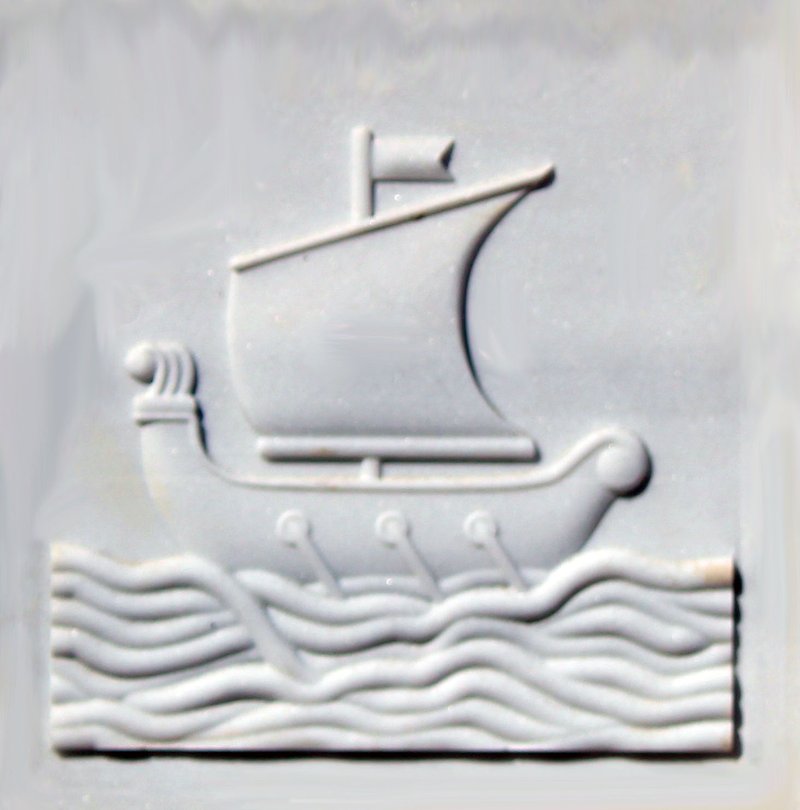
The emblem of Corfu, as told by Homer in the Odyssey
Long before Corfu was Venetian, British or Greek, it was said to be Scheria, the island of the Phaeacians, the greatest sailors of the Homeric world. Their ships needed no helmsman and no rudder. Today the Apidalos Naus, the ship without a rudder, is the emblem of Corfu, and this is the story behind it.
Corfu and the land of the Phaeacians
Scheria in the Odyssey
In the Odyssey, the shipwrecked Odysseus is washed ashore on Scheria, a green and prosperous island at the edge of the known world. He is found by the young princess Nausicaa, welcomed in the palace of King Alcinous and Queen Arete, and finally sent home to Ithaca on a Phaeacian ship.
Since antiquity, Corfu has been identified with Scheria. The historian Thucydides already notes that the island was believed to be the home of the Phaeacians, and the identification has been part of Corfiot identity ever since. Homer's story is told mainly in Books 5 to 8 and Book 13 of the Odyssey.
The ship that knows the way
What Homer says
In Book 8, Alcinous promises Odysseus a safe passage and explains why he need not worry about the route. He asks only for his name and his country, because the Phaeacian ships do not need a pilot to find it:
οὐ γὰρ Φαιήκεσσι κυβερνητῆρες ἔασιν, οὐδέ τι πηδάλι᾿ ἔστι, τά τ᾿ ἄλλαι νῆες ἔχουσιν· ἀλλ᾿ αὐταὶ ἴσασι νοήματα καὶ φρένας ἀνδρῶν, καὶ πάντων ἴσασι πόλιας καὶ πίονας ἀγροὺς ἀνθρώπων, καὶ λαῖτμα τάχισθ᾿ ἁλὸς ἐκπερόωσιν ἠέρι καὶ νεφέλῃ κεκαλυμμέναι· οὐδέ ποτέ σφιν οὔτέ τι πημανθῆναι ἔπι δέος οὔτ᾿ ἀπολέσθαι.
Homer, Odyssey 8.557–563
In plain words: the Phaeacians have no steersmen and no rudders, unlike other ships. Their ships know the thoughts and minds of men. They know the cities and the rich fields of every people, and they cross the open sea at great speed, wrapped in mist and cloud, with no fear of damage or of being lost.
This is the idea that gives the emblem its name. Apidalos means "without a rudder" and naus means "ship": a vessel steered by intelligence and by the wishes of those on board, not by a human hand.
A Phaeacian ship at sea
Speed, grace and a black hull
Homer gives us a vivid picture of these ships. In Book 8, fifty-two young men are chosen to crew one. They drag the black ship down to the deep water, set the mast and sail, fit the oars into their leather loops and moor her out in the bay before going up to the palace for a feast.
In Book 7 the ships are described as swift as a wing or as a thought. In Book 13, when the Phaeacians carry the sleeping Odysseus home, the ship runs so fast that not even a falcon, the swiftest of birds, could keep pace with her. Odysseus sleeps soundly all the way, and wakes on the shore of Ithaca.
Poseidon and the ship of stone
The end of the story
The gift of the Phaeacians came at a price. They were the favourites of the sea god Poseidon, but by carrying Odysseus home they helped a man the god was pursuing. Alcinous remembers an old prophecy of his father: one day Poseidon would wreck a Phaeacian ship returning from such a voyage and hide the city behind a great mountain.
In Book 13 the prophecy comes true, at least in part. As the ship comes back into the harbour, in full view of the people on the shore, Poseidon strikes it with his hand and turns it into stone, rooted to the seabed. The Phaeacians cry out in amazement, and Alcinous orders a sacrifice of twelve chosen bulls to calm the god.
According to local tradition, the petrified ship is the small, wooded island of Pontikonisi, off Kanoni near Corfu Town. It is one of the most photographed views in Corfu, and a short boat ride takes you across to the tiny chapel on the island.
The Apidalos Naus today
Where to see the emblem
A metal sculpture of the Apidalos Naus, made by the Swiss artist Kleio Brenner together with Kostas Panaretos, has stood in front of Corfu's New Port since 2003. It greets visitors arriving by sea. Its stone base carries a plaque with Homer's verses, Odyssey 8.555–563, recalling the maritime history of the Phaeacians and the long intellectual tradition of the island.
- The New Port, Corfu Town: the sculpture and the verses on its base.
- Kanoni and Pontikonisi: the view of the "ship turned to stone", best late in the afternoon.
- The Archaeological Museum of Corfu: finds from ancient Corcyra, the island's classical past.
- The Old Fortress and the Spianada: the harbour that has welcomed ships for more than 2,500 years.
From our apartments in Ipsos, Corfu Town and Kanoni are around 20 to 30 minutes by car or taxi, so the whole story can be followed in a relaxed half-day trip.
A story for the whole family
Making it come alive
Children enjoy this myth because it is full of images they can picture: a black ship with no captain, a princess doing the laundry at the river, a sea god in a rage and an island turned to stone. If you are travelling with a family, tell the story on the way to Kanoni and then look for the ship together from the viewpoint.
The Odyssey is poetry and myth, and scholars still debate where Scheria really was. Corfu's claim is an ancient and much-loved tradition, and the island has made the rudderless ship its own.